
In a previous piece, I talked about how important simulation is when it comes to the design and optimization of mining machinery. This time, I'm going to continue along those lines. You can read that article by clicking this link. At this point, I'd like to continue our discussion on the more general topic of the role that simulation plays in the natural resources industry. This article will concentrate primarily on applications in the oil and gas industry as well as the viability of utilizing CAE software in an industry that is well-known for being notoriously challenging to work in.
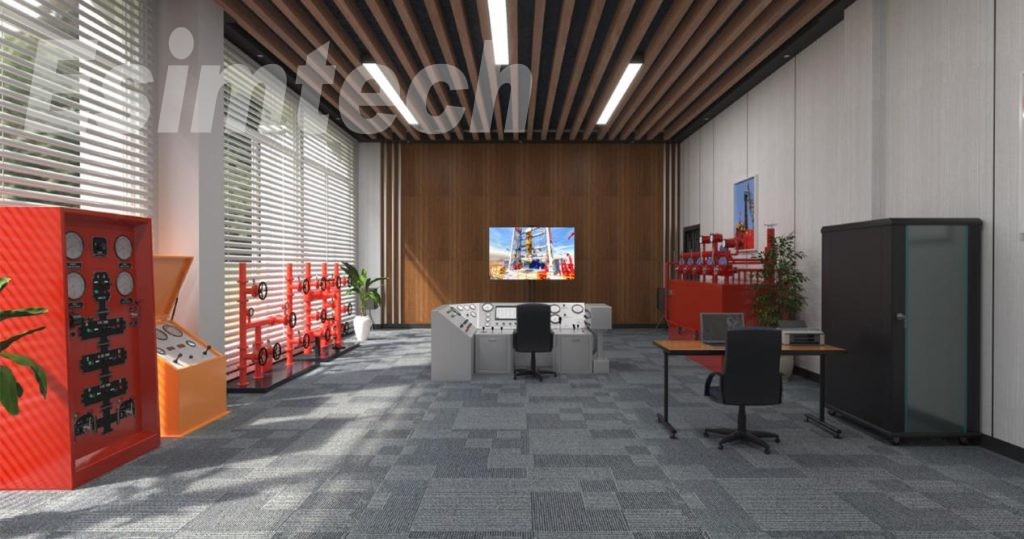
The oil & gas production and transportation simulator requires a wide variety of tools, such as the crown and crown block that are positioned at the apex of the rig, the traveling block, the draw works, the sand pipe, the engine, the fuel or water tanks, the swivel, the rotary hose, the turntable, the pipe rack, the conductor pipe, the borehole, the bit, the drill pipe, the mud pit, and the mud pump.
On the other hand, the drilling process that is necessary for the extraction of oil and gas is already fully comprehended by industry experts. However, a significantly more interesting development is the fact that the same drilling infrastructure can perform seismic surveys based on shock waves.
-
The drilling infrastructure is responsible for transmitting shock waves deep into the earth, where they continue their journey to the center of the planet and are then reflected back to the surface by the various layers of rock
-
As the reflections move through the earth from one layer of rock to the next, the speed at which they move varies according to the type and density of the rock that they encounter at each stage of their journey
-
Vibration detectors or microphones with audio sensitivity are used to pick up the reflected shock waves after the waves have been picked up by them
-
For the parts of the drilling process that take place on land, seismometers are utilized, whereas hydrophones are utilized for the parts of the drilling process that take place underwater
-
Thanks to this method, seismologists are able to interpret the anomalies that are associated with typical structures for gas or petroleum traps and oil
The Petroleum and Natural Gas Industries' Use of Computer Simulation
The types of simulation analyses that are typically utilized to improve the performance of oil and gas equipment include the following examples:
Drilling columns: computational fluid dynamics, thermodynamics, and structural and dynamic stresses
Devices that run on hydropower, including both structural and multiple CFD models, more specifically structural, CFD, and thermodynamic models.
The relationship between fluid dynamics and structural stress in the context of a pipeline network (for transporting petroleum and industrial water).
Storage tanks (fuel tank, oil tank, pressure vessel, etc.)– structural pressure, fluid circulation
Structurally stable as well as mobile oil extraction platforms
On the other hand, it is useful to observe pertinent simulations in examples taken from real-world environments. This is relevant on a level that is more grounded in realism. The following is a list of some interesting oil and gas projects that are being carried out as a part of the Esimtech Public Projects:
1. What Happens When a Wave Strikes the Platform of an Oil Rig
CFD simulation of wave impacts on an oil rig impact simulation simulation of wave impacts on an oil rig
Simulation of Wave Impact Carried Out on an Oil Platform with the Assistance of Esimtech
In the course of this project, a simulation of the impact that waves from the ocean have on the columns of an oil rig will be developed. In order to accomplish this, we make use of a scaled geometry that, despite the scaling, maintains the Froude number of the actual phenomenon. snappyHexMesh is the name of the tool that was utilized in order to accomplish the meshing of the geometry on the Esimtech platform. The mesh that was produced as a result consists of approximately 8,500,000 volumes.
2. An Investigation into the Thermodynamic and Structural Functioning of a Pressurized Vessel
Utilization of Esimtech for the purpose of carrying out a thermal structural analysis on a pressurized vessel
The thermal-structural analysis of a pressure vessel was carried out with the assistance of Esimtech.
This simulation is very interesting and has applications in the extraction and preservation of underground excavations. It is a thermal-structural analysis of a pressure vessel. Underground excavation is one area where these applications can be found. The utilization of pressure vessels is typically necessary whenever high-pressure liquids or gases are going to be stored. In the course of carrying out this modeling activity, a copper pressure vessel was taken into consideration. The interior is lined with steel, and it holds water at a temperature of 593 kelvin, which is equivalent to 290 degrees Celsius. This water was cooled by water at a temperature of 293 kelvin, which is equivalent to 25 degrees Celsius.
We are aware that temperatures can change over the course of time, and as a result, we have chosen to carry out this investigation using the transient thermostructural method. Copper was decided to be the material that would be used for the construction of the vessel, while steel was selected to be the material that would be used for the interior coating.
After that, the table containing the material's parameters at a variety of temperatures was uploaded. This table was uploaded after the previous step. The container is fitted with two pipes: the higher pipe acts as an inlet for cold water, and the lower pipe acts as an outlet for hot water. Both pipes are located on the same side of the container. It was important to take into account the possibility of fictitious valves located between the pipes and the vessel. The outcomes of the simulation reveal the temperatures, heat fluxes, and stresses that were existing in the pipes and the vessel at the time of 2020 seconds (33.75 minutes).
3. The Tank Is Moving While Fluids Are Leaking Out of ItWhile You Were Driving
For use in the oil and gas industry, a computational fluid dynamics (CFD) simulation of fluid movement in a moving fuel tank
Sloshing Fluid in a Moving Fuel Tank – CFD Simulation with Esimtech Simulation of Sloshing Fluid in a Moving Fuel TankSimulation of Fluid Moving Around Inside of a Moving Fuel Tank
In addition, the simulation of fluid moving around in a moving fuel tank is an essential part of an important project for the storage of petroleum. This simulation was carried out in a moving fuel tank. The movement of the fuel tank was controlled by the Solid Body Motion option that was available for the fuel tank. The geometry is a cylindrical tank that has a capacity of 30 gallons and is shaped like a cylinder. The SnappyHexMesh was utilized on the Esimtech platform in order to create the mesh for the inside domain, which consists of approximately 0.5 million cells.
For the purposes of this demonstration project, the fluid has been given the characteristics of water, and the second phase has been designated as air. The simulation was finished after a total of approximately 11 hours of time spent running on eight distinct computer cores.
Importing any of the projects that are discussed in this article into your own workspace gives you the ability to use those projects as templates for developing new projects. You are free to browse the Esimtech Public Projects in search of any additional interesting simulations that might be there.